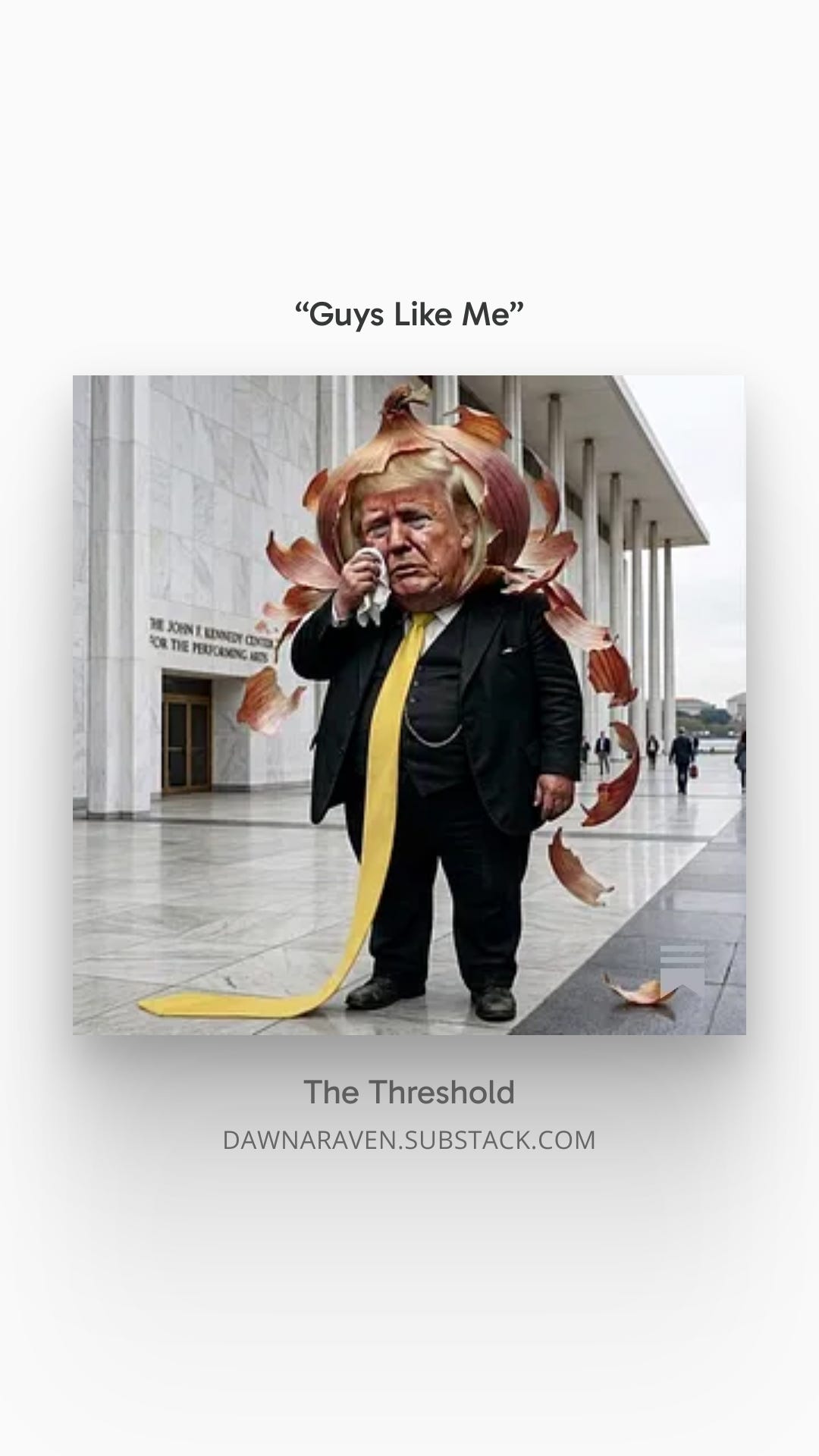
“These people built the country, not the complainers. The complainers didn’t build the country…. Whether it’s fishermen or farmers or anything else. Me. Guys like me, they built the country. And you know, I watch all these ingrates, they’re always complaining, complaining. They didn’t build anything, they couldn’t build anything.”
— Donald Trump, the White House, June 11, 2026
He was asked whether everyday Americans should have a platform in the People’s House. Stop there. Because there’s the blade. The fact that someone had to ask. That a reporter had to stand in the house that belongs to every American — every waterman and farmer and nurse and lineman in this country — and ask the man temporarily living in it whether the people might be allowed a place at the table.
We have been cut. The renovation already told us. The East Wing is rubble. That is not a metaphor. The East Wing was the people’s entrance — the door through which every ordinary American who ever stood in line, requested a tour through their congressman, and walked into their house, entered. The China Room. The Vermeil Room. The Library. The East Colonnade. The Jacqueline Kennedy Garden. The place where First Ladies housed their work for military families and children and literacy. Gone. Demolished. Because an advisor told him he could do anything he wanted. And in its place: a ballroom. No longer necessary, the people’s entrance. Because we no longer have a seat in the People’s House.
And who are the guys like him? They were seated in the front row at his inauguration. Not the Cabinet. Not the generals. Not the fishermen or the farmers or the nurses. Elon Musk. Mark Zuckerberg. Jeff Bezos. Sundar Pichai. Tim Cook. Sam Altman. The ten richest people on the planet, seated ahead of the people’s elected representatives, in the people’s house, on the people’s day — and to be seated there, all they had to do was write a check for a million dollars. The bending of the knee, in the house that belongs to you, on the day the door closed.
In March I published a document called What It Means to Be American. It named the builders of this country, one by one, with their full names and where they came from, because the record was being erased and somebody had to write it down.
Yesterday, the President of the United States answered that document without knowing it exists.
He answered by dividing the country into builders and complainers — and then, in the same breath, told us who the builders were. Whether it be Fishermen? Or Farmers? No, always the correction, the reflex he cannot suppress, his truth arriving the way it always arrives with him, by impulse:
Me. Guys like me.
Take the sentence apart. It won’t take long. It was not built to last.
* * *
The fishermen. I live among them. In my county, on the Chesapeake, my grandfather — a Tangierman — was one. The watermen go out before light and come back when the work is done, not when the workday ends. They pull pots with hands that have been doing it for forty years. They fight the regulators and the weather and the market, and they keep going out, because the water is the work and the work is the life. No man with a gold tower has ever pulled a pot. The fishermen built their piece of this country. He has never met it.
The farmers. George Washington Carver was a Black American, born into slavery in Missouri around 1864, kidnapped as an infant and traded for a horse. He became the agricultural scientist whose work fed the poorest farmers in the South — the actual farmers, the ones with dirt under their nails and nothing else — and when Thomas Edison offered him a fortune to leave, he stayed at Tuskegee. Carver built knowledge and gave it away. That is what building for farmers looks like. It does not look like a tariff press conference.
And the rest of the builders, since he asked. Lewis Howard Latimer, son of immigrants who fled slavery on the Underground Railroad, invented the carbon filament that turned Edison’s light bulb from a novelty into the light of the world. Garrett Morgan, sixth-grade education, son of formerly enslaved parents, invented the gas mask and ran into a burning tunnel to prove it, then invented the traffic signal — every yellow light you have ever slowed for is his. Charles Drew built the blood bank that kept American soldiers alive on every front of the Second World War, for a country that segregated his own blood. Otis Boykin, son of a minister and a housekeeper, built the resistor that made the pacemaker reliable, because his mother’s heart failed when he was a boy. Andrew Carnegie arrived a poor immigrant child and built 2,509 libraries so that children with no money could reach books. The Chinese and the Irish immigrants laid the track that stitched the continent together and were written out of the photograph at Promontory Summit when it was done — but the rails stayed down.
These names are already in the record. I put them there in March. I am putting them here again because the President stood in the People’s House and said the people who built this country were guys like him.
Guys like him inherited four hundred million dollars. Guys like him obtained five draft deferments while other men’s sons went in their place. Guys like him, asked once by a Gold Star father what they had ever sacrificed, answered with their buildings. Not a hospital. Not a library. Not a school. Not a shelter. Not a community center. Not one thing built for anyone who could not pay to get in. Not one thing that advanced the common good of this Nation. Guys like him? Built towers with their own names on them in gold, and a golf resort, and a television character, and a fake university — and then took a wrecking ball to the East Wing of the People’s House to build a ballroom, because an advisor told him he could do anything he wanted.
Latimer lit the homes. Morgan stopped the traffic. Drew filled the veins. Boykin steadied the hearts. Carver fed the fields. Carnegie shelved the books. The Chinese and the Irish immigrants laid the track. The watermen pulled the pots and the farmers brought the harvest and the linemen hung the wire and the operators kept the water clean, and not one of them, not one, ever needed to say so into a microphone, because the country runs on what they built every single minute of every single hour, and it would not notice for one minute if every tower with his name on it went dark.
* * *
And then he kept talking, because he always keeps talking, and the sentence went where that sentence always goes. From “complainers” to the Somalis of Minnesota. To a sitting Congresswoman, with a smear that has circulated for years without one piece of evidence, and a demand that she be thrown out of the country.
In March I wrote down the litany, because it has a rhythm and the rhythm is the point. The Irish were diseased. The Chinese were subhuman. The Italians were criminals. The Jews were vermin. The Japanese were saboteurs. The Mexicans were rapists. The Muslims were terrorists. The Haitians were eating your pets.
June 2026 has now supplied the next line, on schedule. The Somalis are the ingrates.
Every generation, a new face on the same old fear. Every generation, the same machinery: find a target, flood the zone with lies, make the people afraid, claim only you can save them. The target changes. The mechanism does not. Write the litany down in your own house, and leave room at the bottom, because he is not finished adding to it.
* * *
An American
He says she should be thrown out of the country. So set the two Americans side by side, and let the record measure them.
Ilhan Omar was born in Mogadishu. She fled a civil war as a child and spent four years in the Dadaab refugee camp in Kenya before reaching this country. She became a citizen at seventeen — by oath, by choice, by the long road — and Minnesota sent her to Congress. “Here in Minnesota,” she said, “we don’t only welcome immigrants; we send them to Washington.” Donald Trump was born in Queens to a real estate fortune. His citizenship arrived with the inheritance. Neither was a choice. Neither cost him anything.
When a television host questioned her loyalty, she answered: “I took an oath. I took an oath to uphold the Constitution. I am as American as everyone else is.” When a television host asked him — the sitting President, sworn twice — whether he needs to uphold the Constitution of the United States, he answered, on May 4, 2025, on the record: “I don’t know.” Three times in one interview. I don’t know. And four months before that, on the day of his second oath, the two Bibles were held open beside him — the Lincoln Bible, his mother’s Bible — and his hand never touched them. He sells the book for sixty dollars. He would not place his hand on it.
When they called her anti-American, she answered: “No lies will stamp out my love for this country or my resolve to make our union more perfect.” She was quoting the Preamble. He calls her an ingrate — and she has said, plainly, that as an immigrant she probably loves this country more than anyone born to it, and that she is ashamed when it fails to live up to itself. Read that whole, because it is the whole point: that is what love that holds the country to its founding words sounds like. It is the oldest American voice there is. Frederick Douglass spoke in it. King spoke in it. The Founders, criticizing a king, invented it.
One of these two Americans recites the oath from memory because she crossed an ocean to earn it. The other stood between two Bibles he would not touch and cannot say whether the oath binds him. He wants her deported. The Constitution she swore to uphold is the only reason he cannot simply do it. An American is not where you start. It is what you bind yourself to. One of them is bound. One of them told us, three times, that he doesn’t know.
* * *
The Feminine He Binds
And there is a pattern inside the pattern, older than this presidency and sharpened by it. Watch what he does with women who built, who served, who bled, who rose.
Tammy Duckworth was co-piloting a Black Hawk over Iraq in 2004 when a grenade tore through it and took both of her legs. She retired a lieutenant colonel, wears the Purple Heart, and serves in the United States Senate. When he accused Democrats of holding the military hostage, she answered from the Senate floor, on January 20, 2018: “I spent my entire adult life looking out for the well-being, the training, the equipping of the troops for whom I was responsible … I will not be lectured about what our military needs by a five-deferment draft dodger.” She gave him the name that will outlive every tower: Cadet Bone Spurs. She paid for her patriotism in legs. He paid for his deferment in a podiatrist’s favor.
On January 21, 2025, his first full day back in office, he fired Admiral Linda Fagan, Commandant of the Coast Guard — the first woman ever to lead a branch of the United States armed forces. One month later, on a Friday night, his Defense Secretary fired Admiral Lisa Franchetti, Chief of Naval Operations — the first woman to lead the Navy, the first woman to sit as a full member of the Joint Chiefs. Forty years in uniform, nearly half of them at sea. She commanded a destroyer, a destroyer squadron, two aircraft carrier strike groups, the naval forces of Korea, the Sixth Fleet. No reason was given. Her term was cut three years short. By spring, after Vice Admiral Shoshana Chatfield was removed as well, the United States military did not have a single woman wearing four stars. An Army sergeant major who served thirty-five years, Pamela Wilson, said what should not need saying: “I wish people would think about their mothers — are you really saying that this person who bore you is incapable of leading you?”
He fires the firsts. He mocks the wounded. And a jury of ordinary Americans, hearing the evidence under oath — the oath again, always the oath — found him liable for sexually abusing E. Jean Carroll, and liable, twice, for defaming her when she said so. That is not an allegation. That is a verdict, rendered in the People’s name.
So let the record name the women, the way it named the men in March. Dr. Mary Edwards Walker, Civil War surgeon and prisoner of war — the only woman in American history to hold the Medal of Honor. Harriet Tubman, who freed herself and then went back, and back, and back, and in June 1863 guided the raid up the Combahee River that brought more than seven hundred people out of slavery in a single night. Katherine Johnson, the Black mathematician whose calculations carried John Glenn around the Earth — Glenn would not fly until she personally checked the machine’s numbers. Rear Admiral Grace Hopper, who helped teach computers human language and served her Navy past the age of seventy-nine. Hedy Lamarr, who fled the Nazis and co-invented the frequency-hopping that lives today in every wireless signal in this country. Clara Barton, who walked onto battlefields the generals had abandoned and built the American Red Cross out of what she found there.
Half the country he says guys like him built was built by women he would have fired. The feminine he binds keeps building anyway. It always has. It is building this morning.
* * *
Here is the update, and it is short, because the original document already did the work and the President has merely confirmed it.
He said the complainers didn’t build anything. But the people he calls complainers are the record. The immigrant in the patent office, the Black inventor the patent office tried to ignore, the waterman in the dawn, the farmer in the drought, the nurse on the third shift, the lineman in the ice storm, the soldier whose blood reached him in time because Charles Drew built the way. They built it while being told they did not fully belong to it, and they are building it this morning, while a man who has never built anything the republic could keep stands in their house — it is their house — and tells them they couldn’t.
He was right about exactly one man in that room.
He has never built anything. He has had things built. There is a difference — and every man and woman who has ever held a tool knows exactly what it is.
* * *
The Squatter
There’s a squatter in our house.
There is a word for a man who occupies a house he did not build, on land he holds no title to, under a roof raised by hands he sneers at. A man who tears out the walls because an advisor told him he could do anything he wanted. Who has not signed the lease — asked three times whether the house rules bind him: I don’t know. Who will not put his hand on the book, though he will sell you a copy. Who pays nothing, owes everything, and stands in the doorway telling the builders they never built anything. The word is squatter.
He squats in the People’s House — it is not his house; it is your house. He squats in a fortune his father built and a citizenship he never earned and a Constitution he cannot say he’ll keep. He squats on the public’s internet, the soldier’s satellites, the taxpayer’s grants, the immigrant’s labor, the inventor’s light — he used what we built, all of it, every rung, and from the top of the ladder he calls the people who built it ingrates. He says guys like him built the country. The record says the country built guys like him — and that in eighty years he has never once managed the one sentence the whole structure of him exists to avoid: I owe.
Squatters all make the same move in the end. They claim title by occupancy, loudly, and hope the owners forget the deed. But the deed to this country is recorded, and it is recorded in our name — the first three words on the first page. Occupancy is not ownership. The owners keep a calendar. And in this republic, eviction does not come by force or by favor. It comes by ballot, served by the very fishermen and farmers and nurses and linemen and watermen and mothers he swears built nothing, lined up at dawn outside the recorder’s office of the only house that was ever truly his to lose.
Land where my fathers died. Land of the pilgrims’ pride. The fathers who died were not guys like him. They never have been. The deed is ours. It always was.